
Why Has PLM Software Failed to Win Broad Customer Adoption?
PLM has delivered real value in many companies. Yet its defining promise—connected management of a product across its Lifecycle—remains only partially realized. The gap is less about a lack of software than a mismatch between top-down Systems and the realities of Engineering work.
PLM has delivered real value in many companies. Yet its defining promise—connected management of a product across its Lifecycle—remains only partially realized. The gap is less about a lack of software than a mismatch between top-down Systems and the realities of Engineering work.
The promise is larger than the implementation
Product Lifecycle Management (PLM) has been discussed as a business and technology discipline for more than two decades. The ambition is compelling: connect the information, decisions, and processes involved in taking a product from concept through design, production, service, and eventual retirement.
There are many successful PLM deployments, and the category has created lasting value. Still, in a great many enterprises, PLM has not become the single, end-to-end operating backbone that its broadest vision suggests. Important parts of the Product Lifecycle remain spread across specialized Systems, local processes, documents, and the Knowledge people carry with them.
That distinction matters. The issue is not that PLM has failed everywhere. It is that broad adoption and dependable continuity across the full value chain have proved much harder than adopting a useful System for one domain or workflow.
Strong point solutions, fragmented continuity
Engineering and Manufacturing teams rely on capable tools across many disciplines. Model-Based Systems Engineering (MBSE), Computer-Aided Design (CAD), Application Lifecycle Management (ALM), Product Data Management (PDM), Computer-Aided Engineering (CAE), Simulation Process and Data Management (SPDM), and Manufacturing Execution Systems (MES) each address important needs. They are not all PLM products, nor are they interchangeable; they sit alongside PLM and may connect with it in different ways.
These tools can improve the work they are designed to support. A CAD environment can manage design Data; an ALM System can support Software Development; MES can coordinate Shop-Floor execution. The difficulty appears at the boundaries: when a change in one domain needs to be understood, assessed, approved, and acted on in another.
Digital Continuity is often described as if connecting Systems were enough. In practice, continuity also depends on shared meaning, traceable relationships, timely context, and clear ownership. A Product Structure, requirement, Simulation Result, software change, Manufacturing Instruction, and field issue may each be recorded somewhere, yet still fail to form a usable account of how they affect one another.
The result is a familiar paradox: organizations can have more Engineering software than ever and still struggle to see the whole product story. The tools may be valuable; the connections between their Data and the decisions people make are often incomplete.
Why top-down best practices miss the work
PLM vendors bring broad industry experience and proven patterns. Standard processes and out-of-the-box capabilities can give organizations a useful starting point. But a Model designed from the top down cannot fully anticipate the day-to-day conditions of every Engineering Team, Product Line, supplier network, or factory.
The work on the ground is shaped by exceptions and constraints: legacy Systems, customer-specific Requirements, regional rules, supplier handoffs, product variants, urgent changes, and decisions made across organizational boundaries. Teams also create practical workarounds when official processes do not fit the job in front of them. Those workarounds may contain important Operational Knowledge, even when they are difficult to capture in formal System Models.
When a Platform assumes that an idealized process is already in place, implementation can become an exercise in asking the organization to conform to the System. Sometimes standardization is exactly what is needed. In other cases, the imposed Model misses why the work happens as it does, and users adapt around the System instead of adopting it fully.
The challenge is not that best practices have no value. It is that they need to meet evidence from actual practice. A durable PLM approach must account for both the intended process and the work people really perform.
Engineering is not a finished template
Enterprise Resource Planning (ERP) offers a useful comparison, but not a simple blueprint. ERP also requires configuration and adaptation, and Engineering organizations benefit from standards. Yet Engineering work frequently centers on solving problems that are new, interdependent, and specific to a product or program. A design decision can create consequences across Requirements, safety, software, materials, Manufacturing, cost, and service.
That makes complete uniformity difficult. Teams need repeatable foundations, but they also need room to investigate, compare alternatives, learn from tests, and handle exceptions. If a PLM implementation treats every deviation as noise to eliminate, it can suppress the very problem-solving capability the business depends on. If every team builds its own process and Data Model, the organization loses consistency and connection.
The practical goal is a balance: standardize what should be common, preserve flexibility where the work demands it, and make the relationships between local decisions and enterprise-wide product information visible.
A complementary bottom-up layer
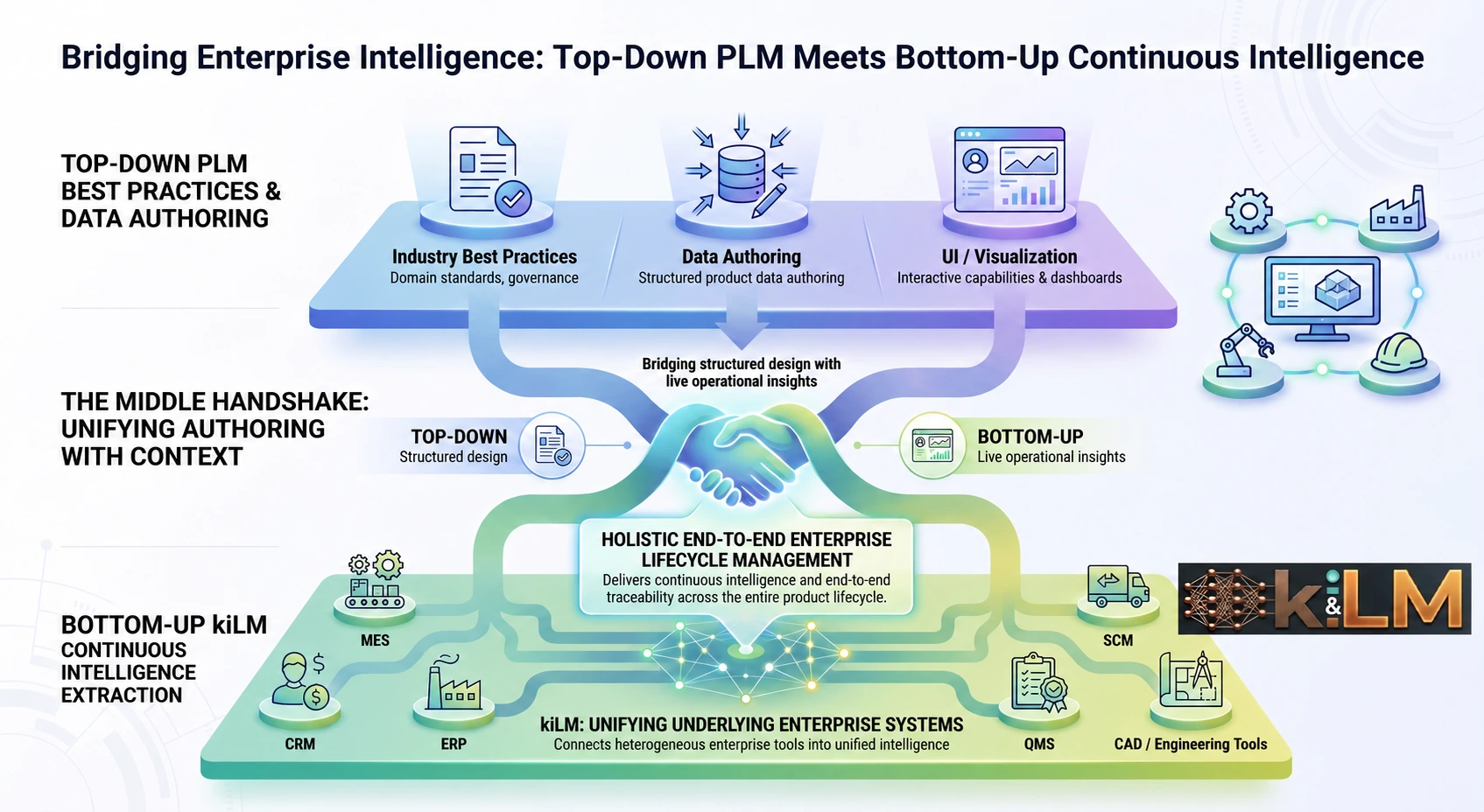
This is where a bottom-up approach can complement the top-down structure of PLM. Instead of starting only with an ideal Data Model and asking teams to fit it, organizations can also begin with the information and work already present across tools and processes.
Data Aggregation can bring scattered records into view. Analysis can help identify patterns, dependencies, gaps, and recurring handoff problems. Knowledge Extraction can make useful context easier to find and reuse. The aim is not to replace the Systems that own Engineering or product records. It is to help make their information more coherent and useful, then feed that understanding into the PLM environment and related workflows.
For this to work, the bottom-up layer and PLM need to operate in tandem. PLM can provide structure, Governance, and a shared destination for Lifecycle information. Ground-level evidence can show where the structures fit, where they do not, and what Knowledge should be brought into the Model. The feedback loop matters as much as the connection.
Why AI makes the timing different
Large Language Models and other AI techniques have made it more practical to work with information that is varied, distributed, and partly unstructured—such as technical documents, change records, issue descriptions, and accumulated Operational Knowledge. Used carefully, they can help people locate relevant context, connect related information, and extract Knowledge that would otherwise remain difficult to reuse.
AI is not a substitute for sound Data foundations, accountable Engineering decisions, or domain expertise. Generated conclusions need to be traceable and reviewed, especially when they influence product safety, compliance, or design decisions. But AI does create new ways to make dispersed Knowledge accessible and to support the bottom-up understanding that Lifecycle Platforms have often lacked.
This makes the moment both promising and demanding. The opportunity is not simply to add an AI Feature to an existing System. It is to create a practical layer that can adapt to real operating conditions while strengthening the Systems intended to coordinate the Product Lifecycle.
Building the connection
The next stage of PLM adoption will depend on more than broader rollouts or another System of Record. It will depend on connecting enterprise structure with the changing reality of Engineering work: capturing what is happening, understanding why it is happening, and turning that Knowledge into better Lifecycle decisions.
POLYCRACY is focused on this challenge through its flagship kiLM Platform. The underlying idea is to build a ground-level layer for aggregating Data, analyzing it, and extracting Knowledge, so that it can work alongside PLM Systems and help close the gap between intended processes and actual practice.
PLM has not failed because its vision is irrelevant. The vision remains essential, while its realization requires a stronger connection between top-down Systems and bottom-up Knowledge. When these approaches work together, Digital Continuity can move from an architectural aspiration toward a more practical part of everyday product work.